The fuel of rocket
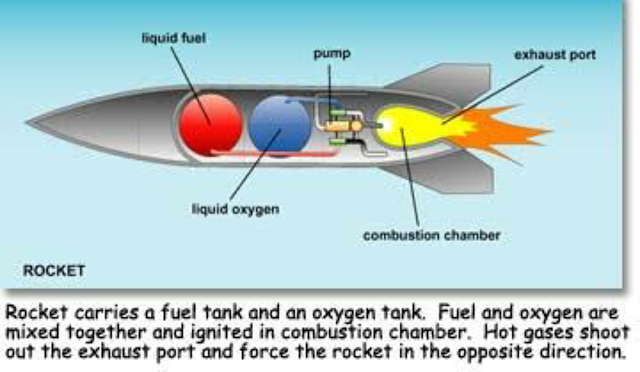
The fuel of 🚀 Bryan K. Smith, chief of the Exploration Vehicle Project Office at NASA's John H. Glenn Research Center, provides the following explanation. A rocket works by exchanging momentum. Both the mass of the propellant and the high velocity of its exit from the engine system give the rocket its momentum. The propellant attains its velocity by burning with an oxidizer in a high-pressure chamber. The resultant high energy exhaust is then funneled through a converging or diverging nozzle. This velocity, coupled with the right mass properties of the propellant, provides the power, or energy, required to get the vehicle into space. Scientists measure the efficiency of rocket propellants by what is termed vehicle specific impulse. This measures the impulse, or change in momentum, per unit of propellant expended. Thrust, or the force generated by the propellant, is another critical property related to the...
